





Table of Content
AI SUMMARY
Quick Answer
A banking app can transfer money in seconds, yet a simple customer question may still take minutes or even hours to resolve. Behind the scenes, bank employees also spend significant time checking documents, reviewing transactions, answering repetitive questions, and processing routine requests.
AI is helping banks handle these tasks more efficiently. It can respond to customer questions, flag unusual transactions, review documents, support lending decisions, and help employees find information faster. More advanced AI in banking can also complete approved actions within defined rules while keeping employees involved in sensitive or high-risk decisions.
So, where is AI actually being used in banking today? In this blog, you will learn the 12 practical use cases, their key benefits and risks, and real examples of how financial institutions are applying AI.
What Is AI in Banking?
AI in banking is the use of technologies that can analyze information, recognize patterns, understand language, produce content, or complete approved tasks within banking operations.
Banks use AI for customer service, fraud detection, lending, compliance, document work, security, and employee support. Some tools provide recommendations, while others handle specific tasks. The level of AI control should match the risk, with stricter approval for decisions that can seriously affect customers or the bank.
KEY TAKEAWAY
AI Agents: Why Banks Can No Longer Ignore Them
AI agents help banks automate routine work, improve customer service, reduce manual effort, and handle complex tasks faster.
How Does AI Work in Banking?
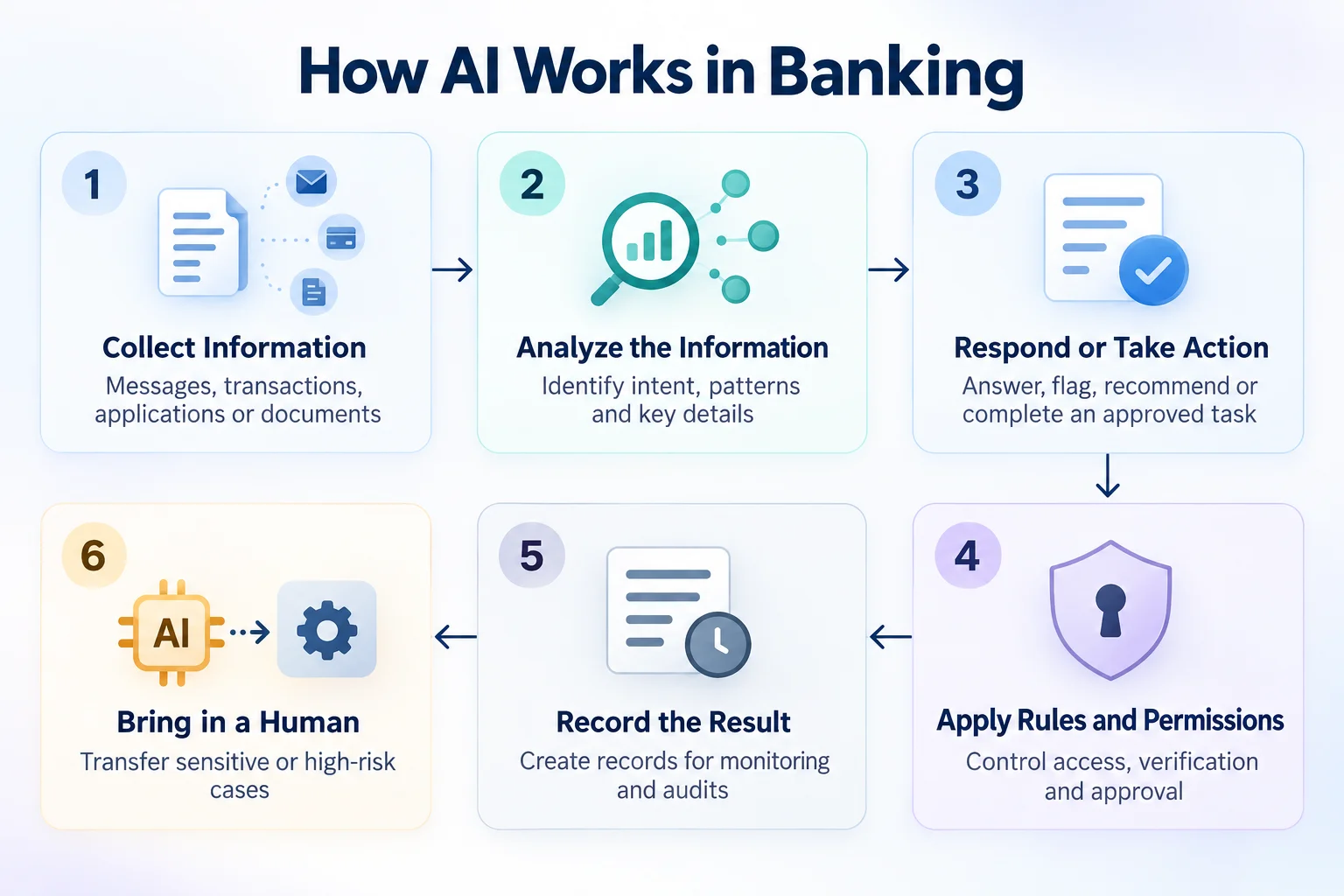
Most banking AI systems work through a simple step by step process. They take in information, make sense of it, decide what needs to happen, and keep a record of the result.
1. Collect information
First, the AI gets the information it needs. This could be a customer’s message, transaction details, loan application, identity document, or data from another approved banking system. For example, if a customer asks about a recent payment, the system pulls the relevant transaction details before responding.
2. Analyze the information
Next, AI looks at the information to figure out what it means. It can recognize what a customer is asking, pick out important details from a document, spot unusual activity, or look for patterns in financial data.
3. Respond or take action
After processing the information, AI can give an answer or carry out a task it is allowed to handle. It might answer a customer’s question, flag a suspicious transaction, recommend a financial product, or update certain account information.
4. Apply rules and permissions
AI still has to work within the bank’s rules. The system controls what information AI can access and what actions it can take. Some tasks can be handled automatically, while others need customer verification or approval from a bank employee.
5. Record the result
The bank keeps a record of what happened. This helps staff review AI activity, investigate problems, track decisions, and provide records when an audit or regulatory check is required.
6. Bring in a human when needed
AI does not have to handle every case on its own. If a situation is sensitive, unusual, or too complicated, the system can pass it to a bank employee. The employee can then review the case and make the final decision.
Types of AI Used in Banking
| Technology | What it does | Banking example |
|---|---|---|
| Machine learning | Finds patterns and predicts probable outcomes | Fraud detection |
| Natural language processing (NLP) | Understands and produces human language | Customer service |
| Computer vision and OCR | Reads information from images and documents | Identity verification |
| Computer vision and OCR | Reads information from images and documents | Identity verification |
| Predictive analytics | Uses historical data to estimate future events | Credit risk monitoring |
| Generative AI | Creates, summarizes, and organizes information | Employee knowledge assistant |
| AI agents | Use knowledge, tools and rules to complete approved tasks | Service request handling |
One banking process can use different AI tools. For example, digital onboarding can use OCR to read ID details, computer vision to check documents, and machine learning to spot unusual activity. An AI assistant can then tell the customer what is missing or send the application to an employee.
AI in Banking Statistics
Recent evidence shows both the speed of adoption and the need for control:
- 75% of surveyed financial firms already use AI. Another 10% expect to adopt it within three years.
- 94% of international banks in the survey use AI.
- The median number of AI use cases is expected to rise from 9 to 21.
- 55% of reported AI use cases include some automated decision-making. Only 2% were described as fully autonomous.
- One-third of current use cases depend on third-party implementations.
- 46% of firms reported only a partial understanding of the AI technologies they use.
- 84% of firms using AI have an accountable person for their AI framework.
These findings come from the Bank of England and FCA survey of 118 financial firms. They cover financial services more broadly, so they should not be treated as a measure of every banking market. They do, however, show a clear direction: adoption is expanding while governance remains central.
Benefits of AI in Banking
Banks can gain several operational and customer-service benefits from AI.
1. Faster Customer Service
AI can answer common questions anytime and help with simple tasks. Complex cases can be passed to an employee with the customer’s details.
2. Shorter Processing Times
AI can collect information, check documents, and spot missing details. This helps banks process requests faster.
3. Better Fraud Monitoring
AI can review transactions and flag unusual activity. Fraud teams can then focus on higher-risk cases.
4. Greater Employee Productivity
AI can help employees find policies, summarize cases, and prepare replies. This reduces time spent on routine work.
5. More Relevant Customer Support
AI can use customer and product information to give more relevant answers and reduce unnecessary transfers.
6. Consistent Service Across Channels
AI can connect customer conversations across websites, apps, WhatsApp, and social media, helping banks provide consistent support. When connected to an omnichannel customer-service platform, AI can preserve context across supported channels
12 AI Use Cases in Banking: All You Need to Know
The following use cases show how AI supports customer service, operations, risk management and employee productivity across banking.
Customer Experience
Banks always want to offer the best experience to their customers. With the help of AI, they can do it easily.
1. Customer Service and Conversational Banking
Customers regularly ask about balances, transfers, cards, loan applications, branch locations, and account requirements. AI can identify the request, search an approved knowledge source, and provide an immediate answer.
After authentication, a connected AI agent may retrieve permitted account information or start an approved workflow. Complaints, disputed transactions, signs of financial vulnerability, and other sensitive cases should be transferred to an authorized employee.
For example, a customer may ask for an update on a loan application. After verifying the customer’s identity, the AI Agent can retrieve the permitted application status, explain any missing requirements, and transfer unusual or sensitive cases to the appropriate employee. The conversation and handover can also be recorded for monitoring and review.
This approach gives customers faster access to routine information while helping employees receive the context they need to handle more complex cases.
2. Customer Personalization
Banks can use approved account activity, product usage and service history to offer more relevant information. A customer may receive a payment reminder, savings suggestion, or educational guide that fits an identified need.
Personalization should remain appropriate and transparent. Marketing should never be presented as independent financial advice, and recommendations should not pressure customers toward unsuitable products.
3. Collections and Debt Management
AI can help collections teams understand payment behavior, organize cases by urgency, and select an appropriate communication path. It may distinguish between a customer who needs a reminder and one who may need a payment arrangement.
Automated communication must remain fair and respectful. Customers experiencing hardship or vulnerability need clear access to human support.
Banking Operations
Banks handle a lot of customer information and paperwork every day. AI can take care of simple tasks and help employees work faster and keep every operation smooth.
4. Customer Identity and KYC Verification
OCR can extract names, dates, addresses and document numbers from submitted identity files. Computer vision can help identify possible alterations, while comparison tools may support identity checks where local rules permit their use.
Incomplete, inconsistent, or suspicious submissions should go to a trained employee. Banks also need a clear route for legitimate applicants whose documents cannot be processed correctly.
5. Document Processing
Banks manage applications, income records, statements, contracts, and customer correspondence. AI can classify these documents, extract relevant fields, and identify missing information.
Generative AI can also summarize long records for employees. Extracted or summarized information must be checked before it influences a financial decision, particularly when documents are handwritten, damaged, or presented in an unusual format.
6. Loan Processing
AI can check whether an application contains the required documents, identify incomplete fields, and organize cases by complexity. Employees can then spend more time evaluating exceptions instead of completing repetitive administrative checks.
Final lending decisions must follow the bank’s policies and applicable law. AI should support the process without hiding how a decision was reached.
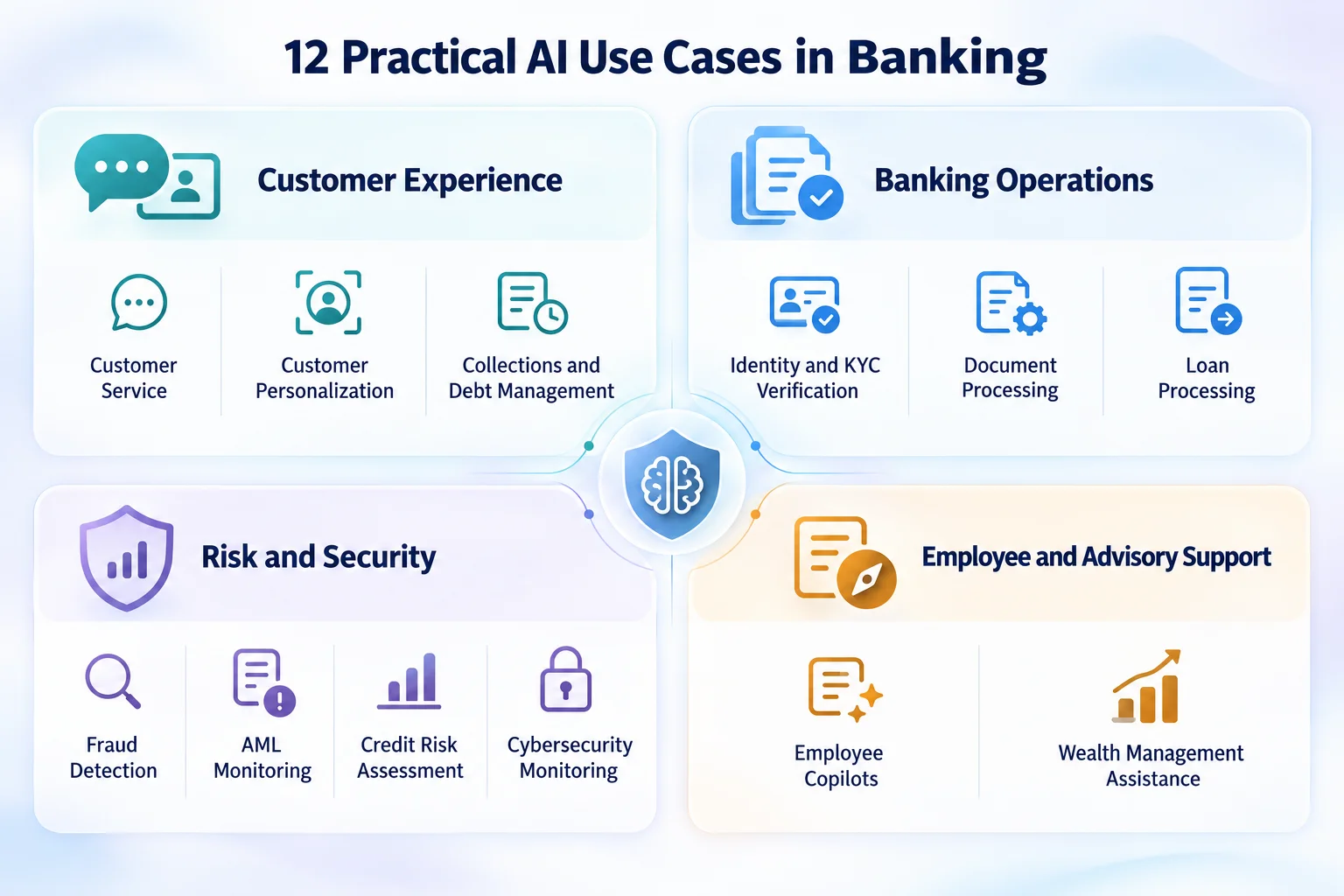
Risk and Security
Banks deal with fraud, suspicious transactions, cyber threats, and credit risks every day. AI can check large amounts of data and help banks spot unusual activity quickly.
7. Fraud Detection
Traditional fraud systems rely heavily on fixed rules. AI adds pattern recognition across factors such as amount, timing, location, device, and previous account activity.
The aim is not simply to generate more alerts. A useful model should improve detection while controlling false positives. Banks need to monitor legitimate transactions that are incorrectly blocked because those mistakes directly affect customer trust.
8. Anti-Money Laundering Monitoring
AI can help compliance teams find connected accounts, unusual payment chains, and behavior that differs from an expected customer profile. It can also rank alerts so investigators can focus on cases that need attention first.
The system should preserve the evidence behind each alert. Formal investigation, regulatory judgment, and reporting remain the responsibility of qualified professionals.
9. Credit Risk Assessment
Credit models require careful testing for fairness and explainability. A bank should understand which information affects the result and provide applicants with an appropriate way to question an important decision.
In the United States, the Consumer Financial Protection Bureau states that creditors using complex algorithms must still provide specific and accurate reasons when taking adverse action against an applicant.
Requirements differ across jurisdictions, but the example shows why explainability remains important in AI-supported lending decisions.
10. Cybersecurity Monitoring
AI can examine login behavior, device information, access patterns, and network activity. It may identify an account takeover attempt or an employee account accessing systems in an unusual way.
AI adds another layer of detection. It does not replace encryption, multifactor authentication, access controls, staff training or incident response planning.
Employee and Advisory Support
AI can also help bank employees with daily tasks and customer requests. It can save time by finding information quickly and helping employees work faster.
11. Employee Copilots
An employee copilot can search internal policies, summarize conversation history, and suggest responses. It can support contact centers, branch employees, compliance teams, and internal service desks.
The best systems show the source behind an answer. This helps employees verify important details and reduces the risk of sharing confident but incorrect information.
12. Wealth Management Assistance
AI can help advisers find research, summarize market information and organize client records. It may also explain general financial concepts or compare possible scenarios.
Personal investment recommendations require suitable professional oversight. Advisers remain responsible for understanding the client’s position, goals and tolerance for risk.
Traditional AI, Generative AI and AI Agents in Banking
Traditional AI, generative AI and AI agents serve different purposes within banking operations.
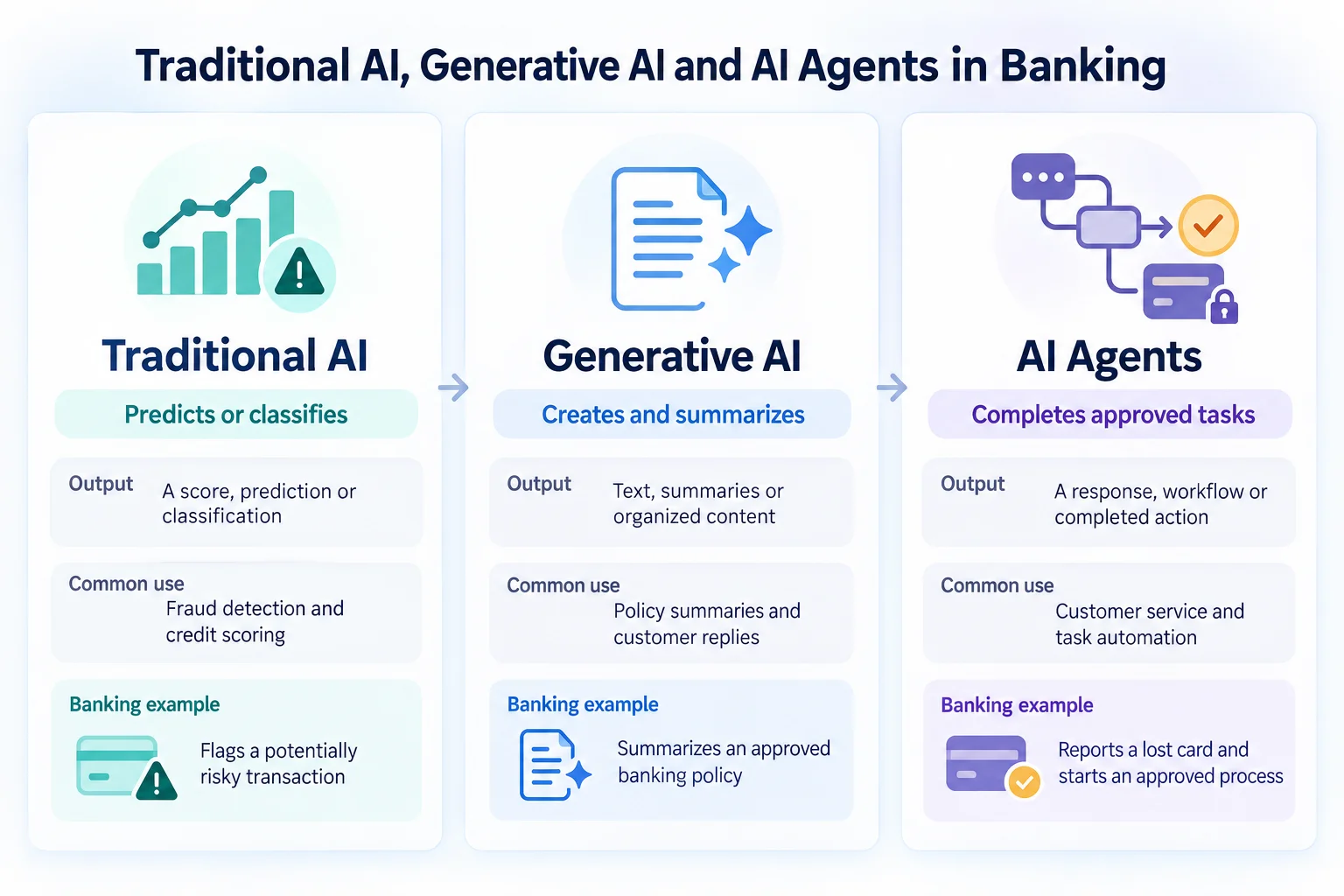
| Area of Difference | Traditional AI | Generative AI | AI Agents |
|---|---|---|---|
| Main purpose | Predicts or classifies information | Creates new content | Completes tasks and takes action |
| How it works | Finds patterns in data | Uses instructions and available information | Understands a request and decides what to do next |
| Common use | Fraud detection and credit scoring | Document summaries and customer replies | Customer service and task automation |
| Output | A prediction, score, or classification | Text, summaries, or other content | A response or completed action |
| Level of action | Usually provides a result | Usually creates content | Can use approved tools to take action |
| Banking example | Flags a risky transaction | Summarizes a banking policy | Reports a lost card and starts an approved blocking process |
For a broader view, read these practical AI agent use cases.
Real Examples of AI in Banking
The following examples show how major banks are applying AI in practice:
Bank of America: Erica
Bank of America launched Erica in 2018 as a virtual financial assistant. In August 2025, the bank reported that Erica had passed 3 billion client interactions and assisted nearly 50 million users since launch.
The bank also reported that more than 98% of users found the information they needed. Erica for Employees was used by more than 90% of Bank of America employees and had reduced calls to the IT service desk by 50%. Long-term performance required continuous improvement, with more than 75,000 updates made since launch.
Morgan Stanley: An Assistant for Financial Advisers
Morgan Stanley introduced an AI assistant to help financial advisers retrieve information from a large collection of internal research and documents. Its official announcement emphasized that advisers remain responsible for serving clients while the system improves access to internal knowledge.
This is a useful model for sensitive work. AI handles search and organization, while a qualified professional retains control of the client relationship and advice.
HSBC: Enterprise AI Across Banking Operations
In 2026, HSBC and Google Cloud announced an expanded strategic AI partnership. The partnership covers customer service, fraud and financial crime detection, risk, compliance, and employee productivity.
The example shows how major banks are approaching AI as an enterprise capability rather than a single chatbot project. It also highlights the need for secure infrastructure and governance when AI connects with several banking functions.
Risks of AI in Banking
Banks should assess the following risks before deploying AI.
- Biased Outcomes: Old data can have unfair patterns. Banks should check AI results across different customer groups.
- Incorrect Information: Generative AI can give wrong answers. Banks should use trusted sources and review sensitive answers.
- Data Privacy and Security: AI should only access the data it needs. Banks also need proper security and access controls.
- Limited Explainability: Banks may need to explain how AI reached a decision. Important decisions should always be open to review.
- Model Drift: Customer behavior and fraud patterns change over time. Banks should monitor AI and update it when needed.
- Third-Party Dependence: Banks may use AI services from other companies. They should know how customer data is handled and have a backup plan.
- New Cybersecurity Threats: AI can create new security risks, such as data leaks and unauthorized actions. Banks need strong controls and regular testing.
Where AI Should Not Act Alone
Human approval should remain in place when an action carries serious financial, legal or customer consequences. Examples include:
- Final credit rejection
- Permanent account closure
- Irreversible money transfers
- High-value transaction blocking
- Account ownership disputes
- Investment recommendations
- Complaints involving customer vulnerability
- Suspected financial crime investigations
- Regulatory reporting
- Exceptions to established policy
Human oversight does not need to slow every process. Its purpose is to keep judgment and accountability where mistakes can cause the most harm.
How to Implement AI in Banking
Banks can use the following process to introduce AI responsibly:
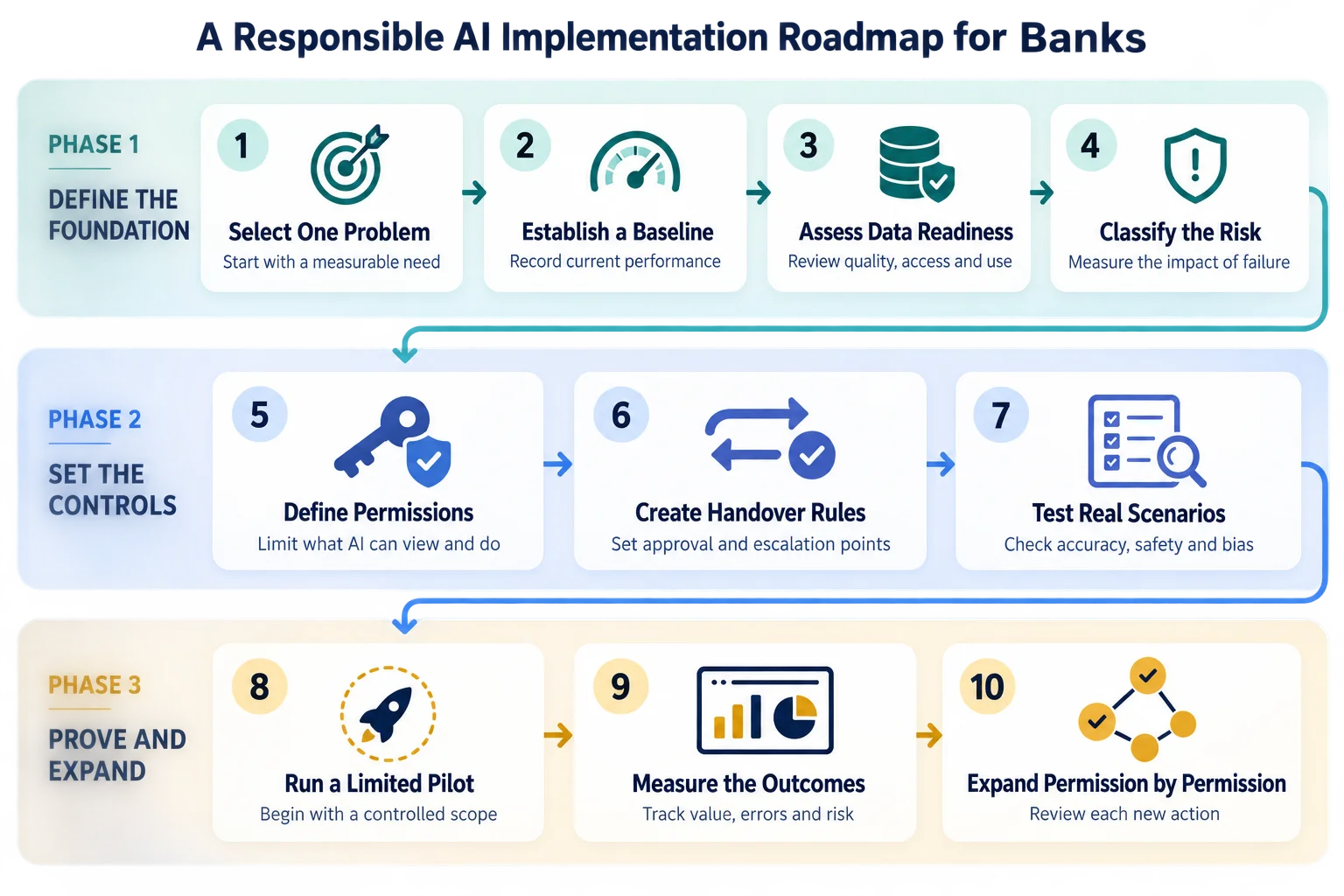
Define the foundation
First, learn about the foundation to implement AI effectively.
1. Select One Measurable Problem
Begin with a defined issue such as long service queues, repeated document checks or slow internal searches.
2. Establish a Baseline
Record current response time, resolution rate, processing cost, error rate, customer satisfaction and employee effort.
3. Assess Data Readiness
Identify what information the system needs, where it comes from and whether the bank may use it for this purpose. Review quality, completeness, access, retention and residency.
4. Classify the Risk
Consider the effect of an incorrect answer or action. A mistake involving branch hours is inconvenient. A mistake involving identity, credit or money movement can have serious consequences.
Set the controls
After the risk is classified, you must move to set controls.
5. Define Access and Permissions
Document what the system can view, recommend, change and complete. Require further approval for higher impact actions.
6. Create Approval and Handover Rules
Specify when an employee must review a response or authorize an action. The system should recognize missing information, uncertainty and sensitive intent instead of guessing.
7. Test Real Scenarios
Testing should cover accuracy, privacy, security, bias, unusual requests, deliberate attacks and system failure.
Prove and Expand
Ensure that while implementing AI, proving and expand is a must.
8. Run a Limited Pilot
Begin with one team, channel, product or customer group. Keep the first use case narrow enough to monitor closely and improve safely.
9. Measure Business and Risk Outcomes
Compare the pilot with the baseline. Review efficiency and customer outcomes alongside errors, overrides, complaints and security events.
10. Expand Permission by Permission
Increase the scope only after the system meets agreed standards. Every additional data source, action or connected system should receive its own review.
How to Measure Banking AI Performance
The right performance measures depend on the banking use case.
| Use case | Useful metrics |
|---|---|
| Customer service | Resolution rate, response time, handover rate and customer satisfaction |
| Fraud detection | Detection rate, false-positive rate and loss prevented |
| Document processing | Processing time, extraction accuracy and manual review rate |
| Lending support | Review time, override rate, fairness and consistency |
| Employee copilot | Time saved, adoption and accepted response rate |
| AI governance | Incident rate, policy violations, unresolved alerts and model drift |
How REVE Chat Supports AI-Powered Banking Service
Customer service is a good place for banks to start using AI. Banks get many customer questions every day, and a lot of them are similar. That is why REVE Chat has introduced an AI agent, ‘Wize AI Agent’, to make customer service easier.
Wize AI Agent can answer common questions, find information from connected sources, follow set rules, and handle approved tasks. It can also collect customer details and pass difficult or sensitive cases to a human agent.
REVE Chat brings customer conversations from supported channels into one place. This helps agents see the conversation history when they take over. Banks still control customer verification, data access, permissions, and approval rules.
Banks can start with one simple use case, such as answering product questions or checking application status. Once it works well, they can add other tasks.
Explore banking customer engagement with REVE Chat or request a demo to discuss your use case.
The Future of AI in Banking
AI in banking is moving beyond basic predictions. Banks are using it to support employees, help customers, and handle routine tasks.
- AI for Employees: AI tools will help staff find information, review cases, and handle daily work.
- Smarter Customer Agents: AI agents will handle more customer requests, such as checking application status or starting simple services.
- Better Fraud Detection: AI will help banks spot unusual transactions and possible fraud faster.
- Connected Banking Systems: AI will work with banking systems to complete approved tasks.
- More Human Review: Sensitive cases will still need human checks.
- Clearer AI Controls: Banks will need clear rules for data access, permissions, and AI actions.
End Note
Finally, AI in banking is already helping banks with customer service, fraud checks, document processing, and everyday employee tasks. But using AI well takes clear rules, safe data access, human checks, and regular monitoring.
Banks do not need to change everything at once. Starting with one simple task makes it easier to test what works and fix problems early.
If you want to use AI for customer service, try Wize AI by REVE Chat. It can answer customer questions, collect information, and handle approved tasks while sending complex cases to human agents.
Frequently Asked Questions
Banks use AI to answer customer questions, detect unusual transactions, review documents, assist with identity checks, support credit teams, monitor cybersecurity threats and help employees find information.
AI can support lending teams by analyzing information and identifying risk patterns. Decisions that materially affect applicants require suitable transparency, fairness testing, human oversight and compliance with applicable rules.
AI can handle repetitive work and help employees find information, but it cannot take responsibility for every customer situation. Employees remain essential when a decision requires judgment, authority, empathy or regulatory accountability.
A bank should begin with a defined problem, establish a performance baseline, review its data, classify the risk, restrict permissions, create human approval rules, test realistic scenarios and monitor results after launch.
AI can be used safely when banks set clear rules for data access, security, and permissions. Sensitive customer data should only be available to systems that need it, with regular checks to prevent misuse or unauthorized access.
Build AI-powered support with Wize AI
Connect business knowledge, automate support conversations, and improve response quality without managing a complex AI stack.
Explore Wize AI Agent Rate the article

Juwel Rana
Senior Content Writer
Juwel is a Sr. Content Writer at REVE Chat. He specializes in writing about customer service and customer engagement. He is passionate about helping businesses create a better customer experience.
He strongly believes that businesses will be able to understand their customers better and ultimately create more meaningful relationships with them.
View all articles
Try Wize AI for Better Banking
Wize AI handles common customer requests and gives your banking team more time for important cases.
Explore Wize AI Today